
Taking a tree down
Tree Removal in Alachua, FL
Short answer
Tree removal in Alachua, FL usually means taking down a big laurel oak, water oak, live oak or pine close to a house, in pieces: a climber or a bucket truck cuts the crown and trunk in sections, the pieces are lowered or dropped into a clear zone, and the brush goes through a chipper. HomeAdvisor's Gainesville-area average for tree removal and trimming is $1,247, with most jobs from $616 to $1,808 (HomeAdvisor, undated, checked Nov 28, 2026).
Before any cut, the contractor works out whether the tree crosses a permit line. In the City of Alachua that is a heritage tree of 30 inches; in the county, 20 inches on a lot of an acre or less; in High Springs' developed neighborhoods, over 30 inches; in Newberry, 12 inches.
Which trees get removed most around Alachua?
The same handful of species fill most yards in the City of Alachua, High Springs, Newberry and north Gainesville, and each comes down differently:
- Laurel oak. Fast-growing, common and short-lived; the University of Florida puts its life span at 50 to 70 years and notes that trunks and large branches often hollow out (UF/IFAS ENH-707, checked Nov 28, 2026). A laurel oak that already shaded a house built in the 1970s is near the end of that span. A hollow trunk changes how a climber ties in, because the tree can't take the load a sound trunk can.
- Water oak. Similar habits and the same 30-inch heritage line as laurel oak in both the county and Gainesville codes.
- Live oak. Wide, heavy, long-lived limbs that reach far over roofs. Most live oak work is pruning; a removal is a big rigging job, and a large one is very often a heritage tree under any of the local codes.
- Longleaf, slash and loblolly pine. Tall and straight, with the weight at the top. A dead pine near a house is the classic urgent removal, especially after bark beetles get in (pine beetle guide).
- Sweetgum, magnolia, hickory, cherry laurel. Common mid-size yard trees. Sweetgum is listed as "abundant" in the county code; southern magnolia and hickories are on Gainesville's high-quality list.
- Camphor tree and Chinese tallow. Invasive trees that turn up along fence lines. The City of Alachua's code exempts removal of nuisance and invasive species.
How does a removal near a house actually work?
Most removals here follow the same sequence, whatever the tree:
- Look at the tree and the ground. Decay at the base, cracks, a lean, dead limbs, the roof, fences, a pool cage, the septic drain field and the wire to the house. In deep sand, the contractor also looks for soft spots where a truck or crane outrigger could sink.
- Pick the method. If there's open space as long as the tree is tall, it can be felled whole with a notch and back cut. Close to a house, it comes down in pieces.
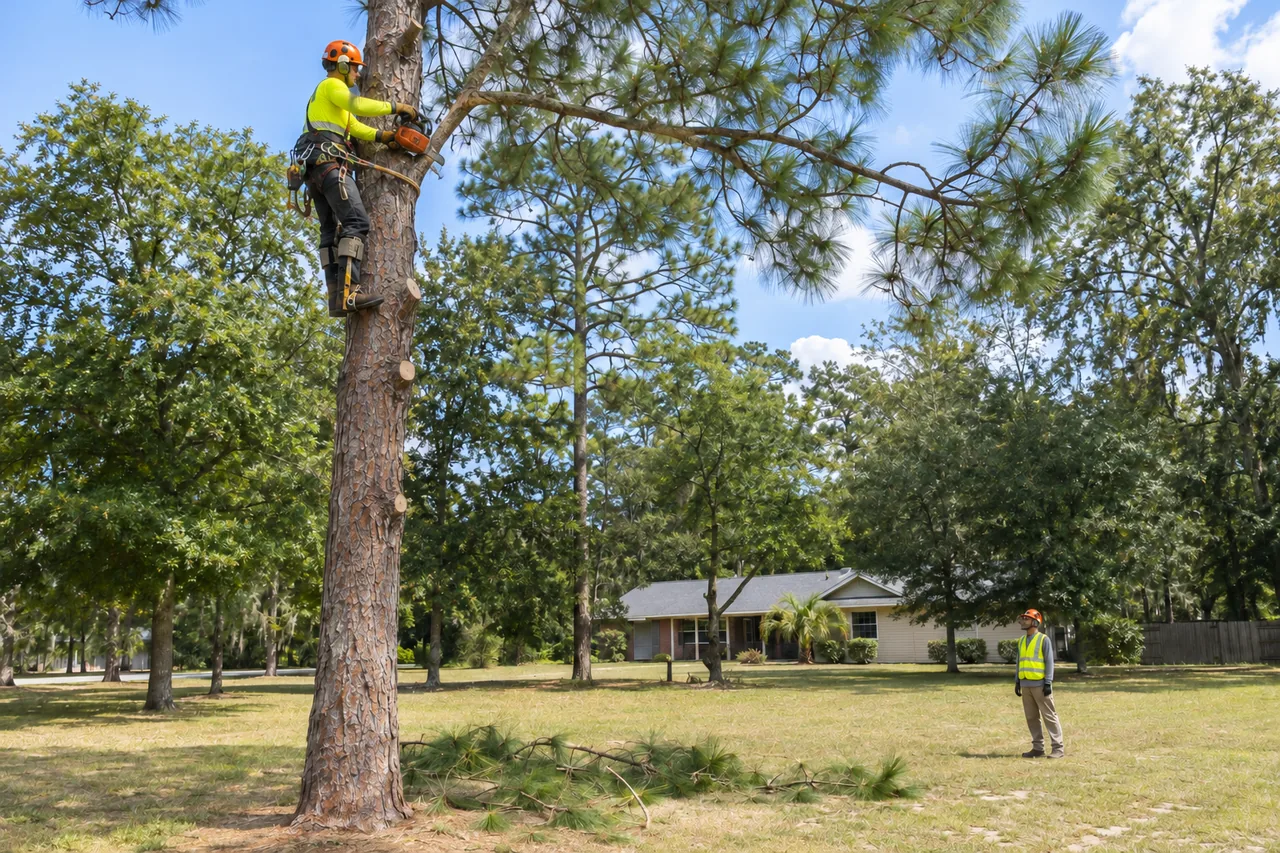
- Take the crown off. A climber ties in high in the tree, or a bucket truck reaches up from the driveway, and cuts limbs from the top down and outside in. Heavy limbs are tied off and lowered on ropes through a pulley set above the cut, with a groundworker controlling the line.
- Take the trunk down. In sections short enough to drop or lower safely, onto a clear pad of ground or onto logs laid out to protect the lawn.
- Clean up. Brush goes through a chipper hitched to a chip truck. Logs are cut to length and hauled, or left if you asked to keep the wood.
- The stump. Cut low; grinding is usually a separate line on the price (stump grinding).
When does a removal need a crane or bucket truck?
A bucket truck needs a firm path to within reach of the tree, which on a sandy lot with a septic system or an irrigated lawn isn't always possible. A crane comes in when the tree is too decayed to climb safely, or so wide over the house that pieces can't be lowered without hitting the roof. HomeGuide adds $500 to $2,500 a day for crane work (HomeGuide, undated, checked Nov 28, 2026). The crane sets outriggers on pads to spread its load, and sand is exactly the ground where pads matter.
A hollow laurel oak is often the case where a crane is the safer choice: a climber can't trust the trunk to hold his tie-in point, and the crane holds each section before the cut.
Does the removal need a permit?
For a tree at a single-family house, it depends where the house is:
| Location | Permit needed for | Office |
|---|---|---|
| City of Alachua | Heritage (30 in. and up) and champion trees only; pines aren't regulated trees | Planning and Community Development, (386) 418-6121 |
| County, lot 1 acre or less | Native trees 20 in. and up; laurel and water oak 30 in. and up | County Forester, (352) 374-5249 |
| County, lot over 1 acre | Trees 8 in. and up | County Forester, (352) 374-5249 |
| Gainesville | Heritage trees (20 or 30 in. by species), high-quality species anywhere, others in the setback | Urban Forestry, (352) 393-8171 |
| High Springs | Trees over 10 in.; in already developed residential districts, only over 30 in.; pines 12 in. or less exempt everywhere (LDC 7.05.01-.02) | City Hall (386) 454-1416; permitting (386) 454-7322, option 2 |
| Newberry | Living trees 12 in. and up (the definition lists native species; ask about others) (Code 74-61, 74-63) | Building official, City Hall (352) 472-2161 |
Sources: City of Alachua LDR 6.2.1, Alachua County ULDC Ch. 406, Gainesville Urban Forestry, High Springs LDC Part 7.05.00, Newberry Code Ch. 74, Art. III. A documented risk tree at a single-family home can skip any of them under Florida Statute 163.045.
What does tree removal cost here?
| Item | Range | Source, checked Nov 28, 2026 |
|---|---|---|
| Tree or shrub removal and trimming, Gainesville | $616 to $1,808 (average $1,247) | HomeAdvisor, undated |
| A tree below 30 feet | $150 to $500 | HomeGuide, undated |
| A tree of 30 to 60 feet | $300 to $1,000 | Same |
| A tree of 60 to 80 feet | $650 to $2,000 | Same |
| A tree taller than 80 feet | $1,200 to $2,700 | Same |
| Oak / pine / palm | $250 to $2,500 / $200 to $1,600 / $150 to $900 | HomeGuide |
These are published ranges, not local prices. The contractor's written price after seeing the tree is the real number; the cost page covers trimming, stumps and storm work.
What commonly goes wrong on removals here?
- The trunk is hollower than it looks. Laurel oak decay columns can run "10, 20 or more feet," UF says. A section that seems solid breaks early.
- Trucks sink. Deep sand and wet low spots swallow tires; a rutted lawn or a cracked septic line is the result.
- The wire to the house. A limb dropped on the service wire can pull the mast off the roof. The utility can power the wire down first (which utility).
- The neighbor's side. A tree on the line, or limbs over the fence, needs agreement from the neighbor before the work.
- The permit after the fact. A heritage oak cut without a permit means replacement at up to double rate in the county (ULDC Sec. 406.16.3) or a stop-work order and restoration plan in the city (LDR 6.2.1(H)).
Should the tree come out, or can it stay?
Removal isn't always the answer. A live oak with one dead limb over the roof usually needs a prune, not a removal; a laurel oak with a few dead branches but a sound trunk may have years left. Removal fits when the trunk or roots are failing, the tree is dead, it is damaging a foundation or septic line, or it stands where nothing can be done to make it safe. The oak decline guide lists the warning signs.
Removal questions
Can the wood stay for firewood?
Usually. Ask for it in the written price: rounds cut to length and stacked, or left where they fall.
How long does a removal take?
Most single-tree removals at a house take part of a day. A large oak over a roof with a crane can take a full day or more.
Can a removal happen right after a hurricane?
Often, but crews are stretched. The City of Alachua's manager can waive the tree rules for a set period during a declared emergency (LDR 6.2.1(F)(1)). See the storm guide.