
After a storm
Emergency Tree Removal in Alachua, FL
Short answer
Emergency tree removal in Alachua, FL starts with safety calls, not the saw: 911 for a downed power line or anyone hurt, the electric utility for a tree on a line, then the tree contractor for a tree on the house, the car or the driveway. HomeGuide lists emergency and storm removal at $150 to $250 an hour and fallen-tree removal at $100 to $600 a tree (HomeGuide, undated, checked Nov 28, 2026).
Since 2017, Irma, Idalia, Debby and Helene all put trees on homes or across roads in Alachua County, and Milton brought a 49 mph gust to Gainesville's airport in 2024.
What should I do first when a tree falls on the house?
- Get everyone out of the rooms under the tree and away from any wire. Assume every downed wire is live.
- Call 911 for injuries, fire, gas smell or a power line down. High Springs' storm notices say the same: "If you see a downed power line, dial 911."
- Call the utility for a tree on the line (numbers below).
- Photograph everything before anything moves: the tree, the roof, inside ceilings, the car. Homeowner insurance adjusters ask for these.
- Call the tree contractor. The usual first step is to take the weight off the roof so it can be tarped, then finish the removal.
- Call your homeowner insurance company to open the claim.
| Utility | Number |
|---|---|
| City of Alachua Electric | (386) 418-6185 |
| Clay Electric Cooperative | (855) 939-3840 (outage line on Clay's site) |
| Duke Energy | (800) 228-8485 |
| City of Newberry Electric Utility | (352) 472-2161 |
| Gainesville Regional Utilities | (352) 334-2871 |
Sources: Alachua County, Tropical Storm Elsa update, July 6, 2021; Clay Electric, checked Nov 28, 2026.
What have storms done to trees here?
| Storm | Date | What the report records |
|---|---|---|
| Hurricane Irma | Sept. 10-11, 2017 | Peak gust 53 knots (about 61 mph) at Gainesville Regional Airport; 12.40 inches of rain there; "countywide wind damage included trees down across roads and on homes"; US 441 and US 27 bridges over the Santa Fe River near High Springs closed Sept. 13 for rising water |
| Hurricane Idalia | Aug. 30, 2023 | Gusts to 51 mph near UF; a large tree and power lines down about 3 miles NNE of Newberry; more than 30 downed trees and outages; one indirect death, a man who "crashed into a tree" near SR 20 in Gainesville in heavy rain |
| Hurricane Debby | Aug. 4-5, 2024 | Gusts of 40 to 54 mph; a home in Alachua destroyed by "a tree of unknown size" on Aug. 5; several trees onto homes; flood damage to homes in Gainesville, High Springs, Newberry and Alachua; a tree across SW SR 45 in Newberry caused a crash with one injury; trees blocked SR 222, SR 24 and SR 26 |
| Hurricane Helene | Sept. 26-27, 2024 | 66 mph gust at UF's WeatherSTEM station; tens of thousands without power; a tree crushed a Gainesville home in Willow Bend, injuring one; trees blocked Newberry Road west of I-75 |
| Hurricane Milton | Oct. 9-10, 2024 | Gusts to 49 mph at Gainesville airport; 2 to 3 inches of rain countywide; two public shelters filled and a third opened |
Sources: NWS Jacksonville post-storm reports for Irma, Idalia, Debby, Helene and Milton.
The outages after Helene ran long. On the morning of Sept. 28, 2024, Clay Electric reported 1,150 active outages affecting about 47,000 members across its system, with no restoration estimate yet, and the City of High Springs relayed Duke Energy's target of restoring most customers by 11:59 p.m. Sept. 29 (City of High Springs). After Idalia, as many as half of Duke Energy's Alachua County customers were out on the morning of Aug. 31, 2023 (Alachua Chronicle).
The 2025 Atlantic season passed with no hurricane landfall on the U.S. mainland, the first such year since 2015 (News4JAX, Jan. 6, 2026). No 2026 tropical storm entry for Alachua County turned up in NWS Jacksonville's reports (checked Nov 28, 2026).
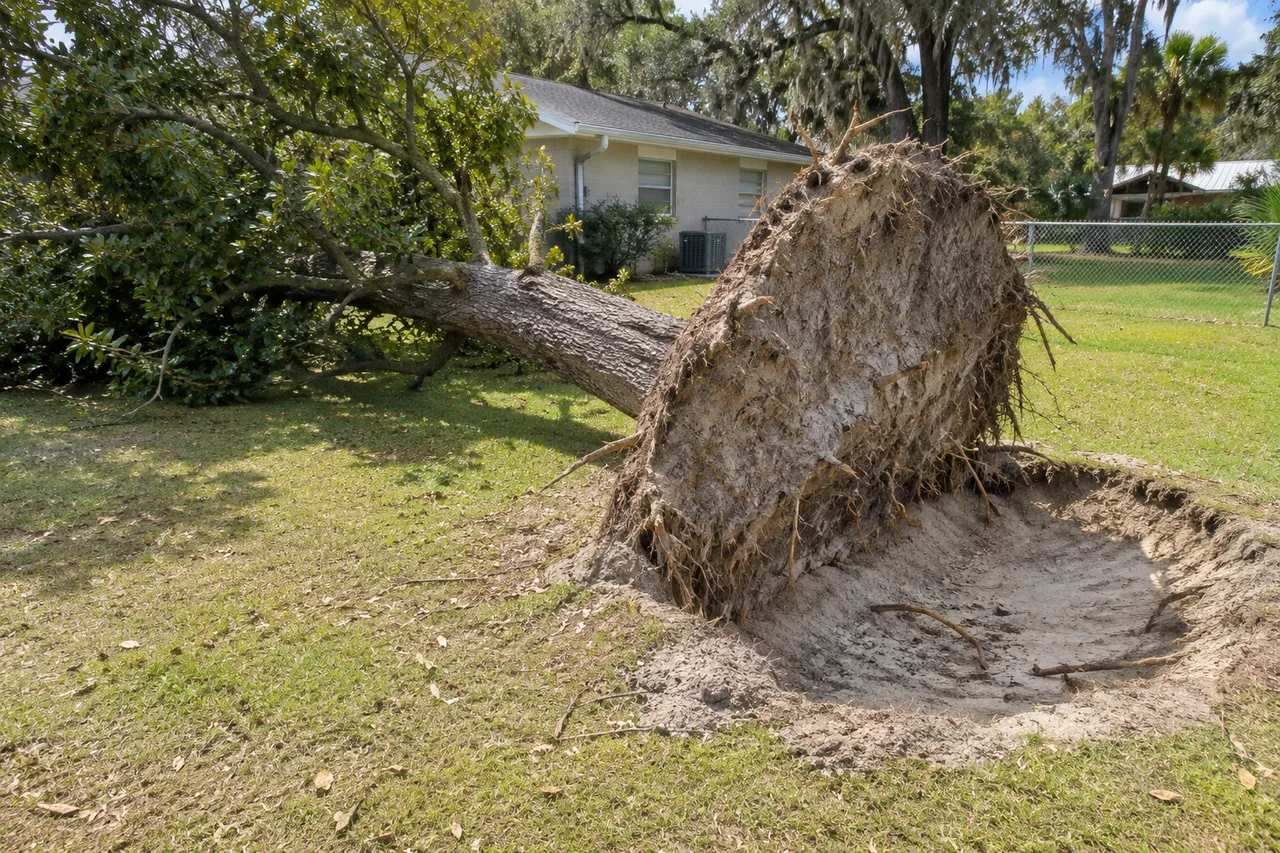
Why do trees here blow over instead of breaking?
Many do both, but uprooting is common in deep sand. Roots in sand spread wide and shallow over the loamy subsoil, and when days of rain soak the sand, it loses grip. Irma dropped more than 12 inches on Gainesville; Debby dropped 8.75 inches at a CoCoRaHS gauge near Brooker. Wet sand plus gusts over 50 mph tips a heavy-crowned oak over, root plate and all, leaving a wide, shallow crater. Hollow laurel and water oaks snap instead. More on the soils page.
What if the tree is on a power line?
Stay back and call the utility; no tree crew should touch a tree that is on or tangled in a primary line until the utility has cleared or de-energized it. Clay Electric says it does not clean up storm debris, so once the line is safe, the tree on your property is yours to remove (Clay Electric, checked Nov 28, 2026). For the wire from the pole to the house, see trees and power lines.
Do I need a permit to clear storm damage?
In the City of Alachua, the City Manager can waive the tree rules "for a definite period of time" during a declared emergency (LDR 6.2.1(F)(1)); otherwise the hazardous-tree exemption covers a tree the LDR Administrator finds needs immediate removal. In the county, the emergency exemption in ULDC Sec. 406.13(b) is for utilities and public entities, so a broken heritage tree that is still standing may still need the County Forester's sign-off or the state risk exemption. In High Springs, the city commission can suspend the city's tree rules by resolution during an emergency (LDC Sec. 7.05.03, checked Nov 28, 2026). A tree already on the ground is cleanup, not a removal decision.
What happens to storm debris?
After Helene, High Springs started debris pickup on Sept. 30, 2024, asked residents to leave piles "on the side of the road, clear of trees, utility poles, etc.," lifted normal size limits, and took only yard debris, no treated wood, fencing or roofing (City of High Springs). The county and each city announce their own rules after a storm. Ask whether the contractor's price includes hauling the wood or stacking it at the road.
Is there a law against storm price gouging?
Yes. Florida Statute 501.160 applies during a declared state of emergency and covers "goods, services, materials" and other commodities needed because of the emergency. A price is prima facie unconscionable when it shows a "gross disparity" from the average price in the 30 days before the declaration, unless added costs or market trends explain it (2026 Florida Statutes, s. 501.160, checked Nov 28, 2026). The Attorney General's price gouging hotline is 1-866-966-7226 (Alachua County).
What can be done before hurricane season?
- Have dead pines near the house taken down; a dead pine only gets more brittle, and it is all weight at the top.
- Have deadwood taken out of laurel and water oaks over roofs and bedrooms.
- Look for new cracks, fresh lean or mushrooms at the base after every heavy rain.
- Keep the outage numbers and the contractor's number somewhere that works without power.
Storm questions
Will homeowner insurance pay for the tree?
That depends on the policy. Many cover removing a tree that fell on an insured structure; fewer cover a tree that fell in the yard and hit nothing. Ask the adjuster before the wood is hauled off.
How fast can a crew come after a big storm?
Trees on occupied houses go first. Expect waits after a widespread storm.
Should a leaning tree be cut right away?
If it is leaning toward a house or road and the root plate is lifting, yes, call now. A pine that lost its top in the wind may die later; bark beetles find storm-stressed pines (pine beetle guide).