Trees that fail
Laurel Oak and Water Oak Decline in Alachua, FL
Short answer
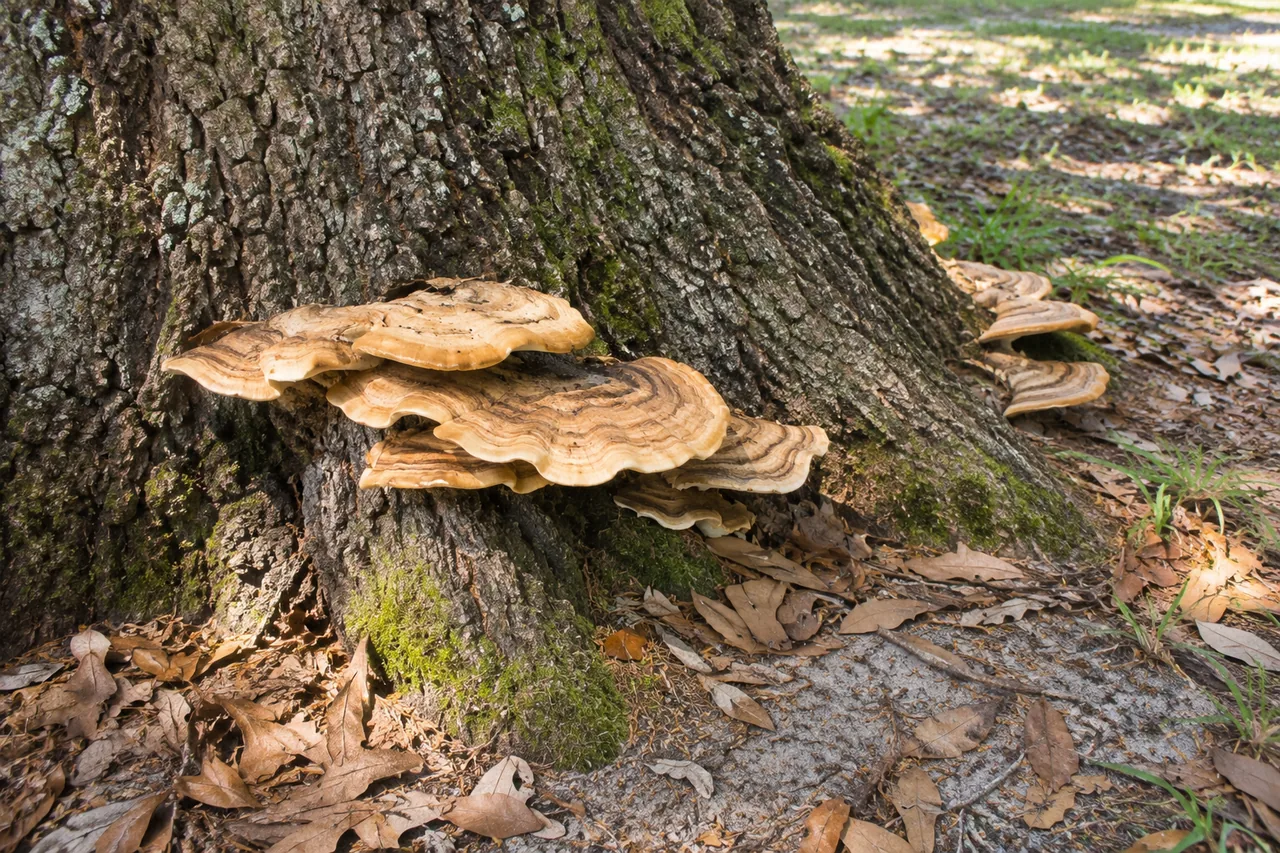
Laurel oaks and water oaks around Alachua, FL decline from the inside: the University of Florida gives laurel oak a life span of 50 to 70 years and says its trunks and large branches often hollow from decay, with rot columns from small wounds or bad pruning cuts running "10, 20 or more feet long" (UF/IFAS ENH-707, rev. Dec. 2018, checked Nov 28, 2026). Conks at the base, dead limbs in the top, cavities and a growing lean are the signs that removal or heavy pruning is near.
Alachua County's code calls both trees "abundant species," "Common species that are widely planted or are short lived," and lets them reach 30 inches before they count as heritage trees (ULDC Sec. 406.11(b)).
Why do laurel and water oaks fail sooner than live oaks?
They grow fast and get big quickly, 60 to 70 feet tall and 35 to 45 feet wide for laurel oak according to UF, but their wood doesn't resist decay the way live oak does. UF's fact sheet lists laurel oak as "susceptible to breakage," notes that trees from drier sites are thought to have stronger wood, and recommends more durable oaks such as live, Shumard, southern red and bluff oak for streets and parking lots for that reason.
The local codes reflect it. Gainesville's single-family rules let water oak, laurel oak, sweetgum and slash and loblolly pine reach 30 inches before they become heritage trees, while live oak, southern red oak, bluff oak and others count at 20 inches and sit on its high-quality list (City of Gainesville, checked Nov 28, 2026). The county does the same with its 30-inch heritage line for laurel and water oak.
What are the warning signs on an old oak?
| What you see | What it usually means |
|---|---|
| Shelf-like mushrooms (conks) at the base or on the root flare | Root or butt rot. The Florida Forest Service says multiple conks at the base indicate extensive decay |
| Flat, crusty fungal patches on the trunk where bark has fallen | Hypoxylon canker, which affects hardwoods; patches on the main trunk usually mean the tree is dead or dying |
| Dead branches in the top of the crown | Roots or trunk failing to feed the crown |
| Cavities, especially where big limbs were cut years ago | Decay columns running up and down from the wound |
| Cracks or seams in the trunk; a hollow sound when tapped | Internal decay or a structural crack |
| A new lean, with cracked or heaved soil on the far side | Root failure; urgent |
| Limbs dropping on calm days | Decay at branch unions; a sign the crown is no longer sound |
Sources: Florida Forest Service Leaflet 23, June 2019; UF/IFAS ENH-707. Checked Nov 28, 2026.
Do storms make it worse?
Yes, in two ways. First, storms expose decay that was already there: a hollow oak that stood for years snaps in its first 50 mph gust. Hurricane Helene's gusts reached 66 mph on the University of Florida campus in 2024, where "numerous trees fell," including a large oak into the Norman Hall courtyard (NWS Jacksonville). Second, the Forest Service notes that hidden wind damage can cause decline for "months or even years" after a hurricane, as cracked roots and twisted limbs let decay in.
What should I do about a declining oak?
- Look at what it would hit. A hollow laurel oak over a pasture is a different question from one over a bedroom.
- Get it looked at. The contractor can say whether the problem is in the limbs (pruning) or in the trunk and roots (removal).
- Take deadwood out soon. Dead limbs over a roof, a driveway or a play area shouldn't wait for the next storm.
- If removal is the answer, check the size. Under 30 inches, a laurel or water oak needs no permit on a county house lot of an acre or less, or on a Gainesville single-family lot. Inside the City of Alachua, it needs one only at heritage size, 30 inches. In Newberry, the permit line is 12 inches, and diamondleaf (laurel) oak is on the city's species list while water oak is not (Newberry Code Secs. 74-61, 74-63).
- For a big one, think about documentation. A signed ISA risk assessment showing removal is the only way to bring the risk below moderate clears any local permit, fee or replanting at a single-family home under Florida Statute 163.045.
What should replace it?
UF's list of more durable oaks is a good start: live oak, Shumard, southern red, bluff, pin, northern red and bur oak. Gainesville's high-quality list adds southern magnolia, Florida maple, longleaf pine, hickories and others. In the City of Alachua, a required replacement must be Florida No. 1 grade or better and at least half shade trees (LDR 6.2.1(D)). Plant well back from the house and away from overhead lines; Clay Electric says plainly, "Do not plant trees if power lines are overhead" (Clay Electric).
What other trees decline here?
- Pines die quickly from bark beetles after drought or storm stress (pine guide).
- Hardwoods with ambrosia beetles: the Forest Service lists fine, light-colored sawdust columns at the base of a tree as a sign of ambrosia beetle infestation.
- Cabbage palms can be killed by lethal bronzing, which the Forest Service began surveying for in forests in 2025 (Forest Health Highlights 2025).
Oak questions
Can a hollow oak be saved?
A tree can stand for years with some hollowness if enough sound wood remains around it. How much is enough depends on the tree and what it would hit; that's the judgment a risk assessment makes.
Is cabling an option?
For a split between two sound stems, sometimes. It doesn't help a decayed trunk or root rot.
Are water oaks protected?
Only at 30 inches in the county and Gainesville, and only as heritage trees. In the City of Alachua, the 30-inch heritage line applies to every regulated species.