Up the road
Tree Service in High Springs, FL
Short answer
Tree service in High Springs, FL means oaks and pines on karst ground beside the Santa Fe River: removals and trimming at in-town houses, storm cleanup after floods and wind, and dead pines on wooded lots out toward the springs. Inside city limits, the Land Development Code protects trees over 10 inches across, but at houses in already developed residential districts only trees over 30 inches fall under it, and pines 12 inches or less are exempt everywhere (LDC Secs. 7.05.01 and 7.05.02, checked Nov 28, 2026); outside the limits, the county's tree code applies.
Power in and around High Springs comes from Duke Energy or Clay Electric Cooperative, depending on the address; both restored High Springs-area customers after Helene in 2024.
What makes High Springs different for tree work?
High Springs had 6,215 people at the 2020 Census (Florida EDR, 2020 Census), on US 27 and US 441 at the northwest corner of Alachua County. Three things set it apart from the City of Alachua:
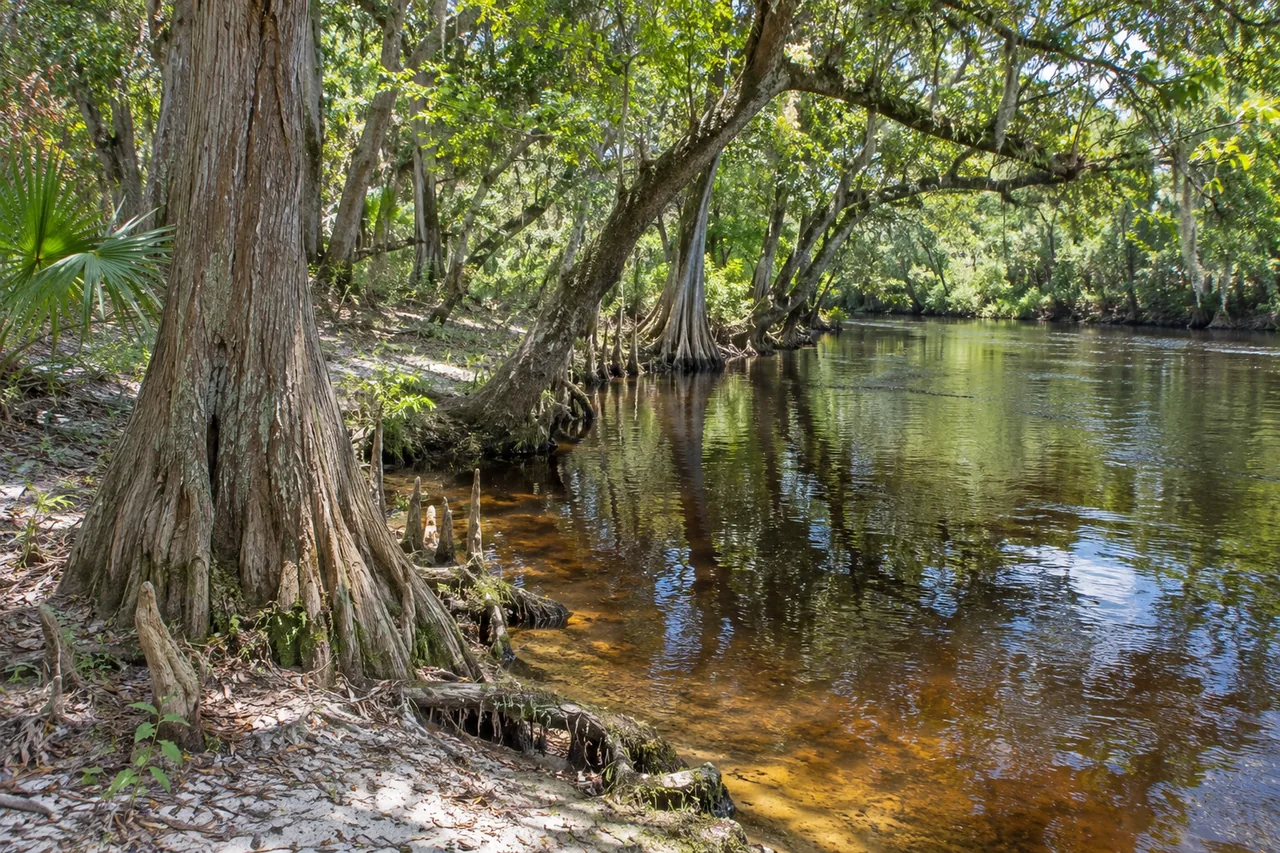
- The river. The Santa Fe River runs along the north side of town, with its floodplain forests and springs. River floods reach farther than most people expect.
- Karst. The limestone is close to the surface. The Santa Fe itself sinks underground at River Sink in O'Leno State Park and comes back up about three miles west at River Rise, after flowing through the Floridan aquifer (Florida State Parks). Sinkholes "most commonly form in western and central Alachua County," where "limestone is exposed or thinly covered by less than 25 feet of permeable sand" (Alachua County, 2012).
- Two utilities. Duke Energy and Clay Electric both serve the area, with different trimming rules.
Does High Springs require a tree removal permit?
For most yard trees at an existing house, no. The city's tree rules are in its Land Development Code, Appendix B, Article VII, Part 7.05.00 (Landscaping). Sec. 7.05.01 protects "all trees listed as endangered and all trees greater than ten inches in diameter at four feet above the natural ground," unless Sec. 7.05.02 exempts them, and Sec. 7.05.02 does exempt two large groups:
- "In already developed residential districts, all trees 30 inches or less in diameter (7.85 ft. circumference) at four feet above the ground shall be exempt from the provisions of this section."
- "In all zoning districts, all pine trees 12 inches in diameter or less (3.14 ft. circumference) at four feet above the ground shall be exempt."
Source: City of High Springs Land Development Code, Part 7.05.00, on Municode (code version of Sept. 25, 2026), checked Nov 28, 2026.
At a house in an established High Springs neighborhood, that means a 24-inch laurel oak is exempt and a 34-inch live oak is protected. On land outside a developed residential district, such as a lot being built on, the 10-inch line applies to everything but pines of 12 inches or less. Endangered species and historic trees designated by the city commission (Sec. 7.05.04) are worth asking about whatever their size.
Where a tree is protected, "Authorization for removal of a tree shall be by permit depending upon the other requirements of this LDC" (Sec. 7.05.05(2)). Notice of each removal application goes to the city's three-member tree preservation committee, and at least one member gets a reasonable chance to comment before a permit issues (Sec. 7.05.05(3)). Sec. 7.05.06 allows a protected tree to come out only for listed reasons, among them a tree so close to a structure that it materially impairs the structure's safety or integrity, material interference with utility lines, a substantial traffic hazard, a tree diseased or weakened by age, abuse, storm or fire and likely to cause injury or damage, or a law that requires removal. And under Sec. 7.05.06(h): "Any tree that has been removed for reasons unrelated to safety must be replaced with a native tree of at least five gallons in size." During an emergency, the city commission can suspend the tree rules by resolution (Sec. 7.05.03).
Before taking down a tree over 30 inches inside city limits, confirm with the city: City Hall is at 23718 W US Hwy 27, (386) 454-1416, and building and permitting is (386) 454-7322, option 2 (City of High Springs, checked Nov 28, 2026).
What does apply regardless:
- Florida Statute 163.045. For a documented risk tree at a single-family home, no city permit, fee or replanting can be required (state law).
- County rules just outside town. A house on High Springs-addressed land outside city limits follows ULDC Ch. 406: heritage trees at 20 inches (30 for laurel and water oak) on lots of 1 acre or less, all trees 8 inches and up on larger lots.
How do Santa Fe River floods affect trees?
After Hurricane Irma in September 2017, the county extended a mandatory evacuation to the Santa Fe River floodplain and to properties near creeks and streams north of NW 441, naming High Springs, the City of Alachua and La Crosse as impacted (Alachua County, Sept. 13, 2017). The U.S. 441 and U.S. 27 bridges over the river near High Springs were closed on Sept. 13 for rising water, and a gauge 3.2 miles southwest of town logged 8.23 inches of rain (NWS Jacksonville, Irma report).
Standing water for days or weeks does slow damage. Roots starve for oxygen, and trees that are not floodplain species (sand-hill oaks, many pines, landscape trees) can decline over the next year or two. Floodplain trees like bald cypress, water oak and red maple take it better. A tree that leans after the water drops, with soil heaved on the far side, has lost its anchor and is a removal, not a wait-and-see.
What did recent storms do around High Springs?
- Hurricane Debby, Aug. 4-5, 2024: homes in High Springs had minor to major flood damage, several trees fell onto homes around the county, and fallen trees blocked SR 26 at NW 242nd St. and other state roads (NWS Jacksonville).
- Hurricane Helene, Sept. 26-27, 2024: at 8 a.m. on Sept. 28, Clay Electric reported 1,150 active outages affecting about 47,000 members across its system, with no restoration estimate yet, and the city relayed Duke's target of restoring most customers by 11:59 p.m. Sept. 29 (City of High Springs). Debris pickup began Sept. 30, with the city warning it would take several days because of "a large number of trees still down" and asking residents to call (352) 955-1818 for a tree blocking a road (City of High Springs).
- Hurricane Idalia, Aug. 30, 2023: Duke Energy expected 95% restoration in High Springs by 11 p.m. Friday, Sept. 1, after as many as half its Alachua County customers lost power (Alachua Chronicle).
In March 2026, the city commission's agenda carried four resolutions approving disaster debris monitoring and debris removal agreements (High Springs commission agenda, Mar. 26, 2026), the contracts a city uses to clear roadside storm debris.
Who trims near the lines in High Springs?
Look at the electric bill: it will be Duke Energy or Clay Electric.
- Clay Electric re-clears rights-of-way every 3 years in cities, 4 in urban areas and 5 in rural areas, inspects each circuit yearly for dead or danger trees, keeps a minimum 10 feet each side of distribution lines, and prunes limbs within 5 feet of service wires on its cycle. It leaves large limbs and trees over service wires to the member, and will power the service wire down for tree work if you call the district office during business hours. Vegetation management: 1-800-511-5998 (Clay Electric, checked Nov 28, 2026).
- Duke Energy asks owners with vegetation near the service drop to "call Duke Energy Customer Service to request the line be de-energized before completing any tree work" (Duke Energy, checked Nov 28, 2026). Outages: (800) 228-8485.
What trees grow on High Springs lots?
In town, expect the usual north-central Florida mix: live oaks, laurel oaks, southern magnolia and pines. Toward the river: water oak, sweetgum, bald cypress and red maple on lower ground. On the sand ridges: longleaf pine with turkey oak, the vegetation the USDA lists for the deep, excessively drained Candler sand (USDA OSD, Candler, rev. 06/2013). Dead pines on wooded lots after a dry spring or a storm are the common call; see the pine beetle guide.
High Springs questions
My address says High Springs. Am I in the city?
Not necessarily. Much of the land with a High Springs address is unincorporated county. The Alachua County Property Appraiser's parcel record settles it.
Can I burn limbs on a wooded lot?
Florida Forest Service rules allow yard waste from your own property in a pile no wider than 8 feet, lit after 9 a.m. Eastern and out an hour before sunset, unless a local rule or a county burn ban says otherwise (FDACS, checked Nov 28, 2026). Bigger piles need a Forest Service authorization.
Does the contractor work near the springs and the river?
Yes, at houses in and around High Springs. Work in a floodplain or near a spring run can draw other rules; the contractor will say if a job needs more than a tree decision.