State law
Florida Statute 163.045 and Risky Trees in Alachua County
Short answer
Florida Statute 163.045 lets the owner of a single-family home in Alachua County prune, trim or remove a tree with no local notice, application, permit, fee or mitigation, if the owner holds signed documentation that the tree poses "an unacceptable risk to persons or property." That documentation is an onsite tree risk assessment done to the International Society of Arboriculture's Best Management Practices – Tree Risk Assessment (2nd ed., 2017) by an ISA arborist or a Florida landscape architect, who signs it (Fla. Stat. 163.045, 2024 edition, checked Nov 28, 2026).
It covers the City of Alachua, High Springs, Newberry, Gainesville and unincorporated Alachua County alike, and no local government can make the owner replant afterward.
What does Section 163.045 say?
The section is short, four subsections, titled "Tree pruning, trimming, or removal on residential property":
- (1) Definitions. "Documentation" is the onsite risk assessment described above, signed by the person who did it. "Residential property" is a detached single-family building on a lot actively used for single-family purposes, as a conforming or legally recognized nonconforming use.
- (2) The exemption. Once the owner holds that documentation showing an unacceptable risk, no county or city can demand any of six things before the tree is pruned, trimmed or taken out: a notice, an application, an approval, a permit, a fee or mitigation. The risk is unacceptable when removal is the only practical way to bring it below "moderate."
- (3) No replanting. A local government may not require the owner to replant a tree pruned, trimmed or removed under the section.
- (4) Mangroves. The section doesn't touch delegated mangrove protection under ss. 403.9321 through 403.9333. No mangroves grow this far inland, so for Alachua County it never comes up.
History: created by s. 1, ch. 2019-155 (effective July 1, 2019), and amended by s. 1, ch. 2022-121. Source: The Florida Senate, 2024 Florida Statutes, s. 163.045, checked Nov 28, 2026. No later amendment showed in that history note.
How do the local codes line up with it?
Each local government around Alachua handles the statute a little differently in its own words:
| Where | How the local code treats it |
|---|---|
| Unincorporated Alachua County | ULDC Sec. 406.13(a), "Hazardous trees," repeats the exemption for "property with an existing residential structure" and ties unacceptable risk to the current ISA tree risk assessment edition (ULDC Ch. 406) |
| City of Gainesville | The Urban Forestry page cites the exemption, gives July 1, 2019 as its start, and asks residents to call the office before acting (Gainesville) |
| City of Alachua | LDR Sec. 6.2.1 exempts most house-lot trees anyway; the statute matters for heritage and champion trees (city rules) |
| High Springs and Newberry | Each city's own permit, under High Springs LDC Part 7.05.00 and Newberry Code Sec. 74-63, gives way to the statute for a documented risk tree at a single-family home; High Springs' replanting rule in Sec. 7.05.06(h) does too |
All the sources above were checked Nov 28, 2026.
What is a tree risk assessment, in practice?
It is a site visit and a written report, not a phone call or a quick opinion. The ISA method the statute names looks at three things:
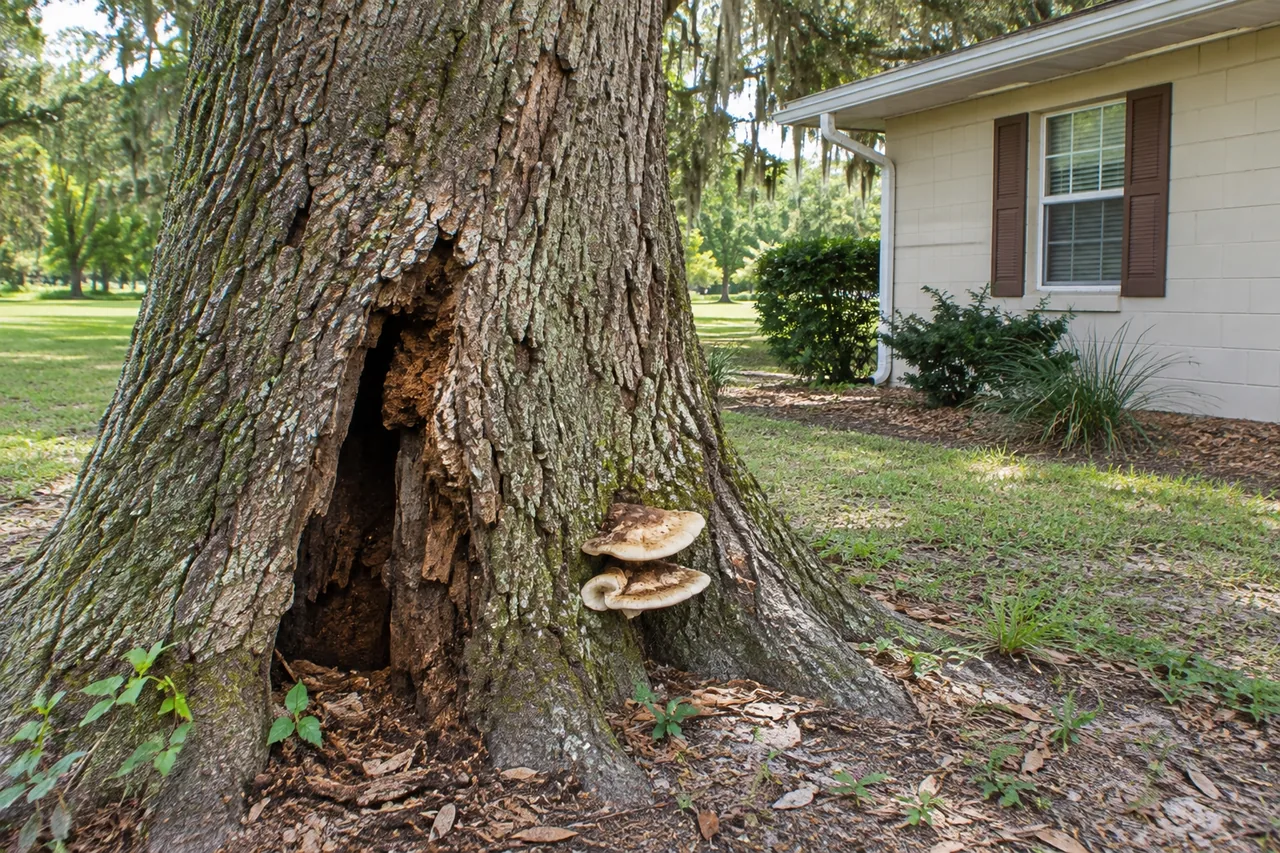
- Likelihood of failure. Is a part of the tree likely to break or the whole tree to fall within a set time frame? Decay, cracks, a hollow trunk, root damage, a lean that has worsened, dead limbs.
- Likelihood of impact. If it fails, what will it hit? A roof, a bedroom, a driveway the family uses daily, a power line, an empty pasture.
- Consequences. How bad would that be?
The three combine into a risk rating. Under the statute, the exemption only applies when the assessor concludes that removal is the only practical way to bring the risk below moderate. A tree rated moderate, or one where pruning or cabling would bring the risk down, doesn't meet it.
In Alachua County the trees that most often end up in these reports are big laurel oaks and water oaks, which the University of Florida says hollow out with age and have a 50- to 70-year life span (UF/IFAS, checked Nov 28, 2026). See the oak decline page for the signs.
Who can sign the documentation?
The statute names two kinds of professionals, and only these two: an arborist holding the International Society of Arboriculture's arborist credential, or a Florida landscape architect. The person who did the onsite assessment signs it. A tree company's own opinion, a neighbor's or a home inspector's isn't the documentation the statute describes unless it comes from one of those two and follows the ISA method.
When the contractor who does the removal also arranges the assessment, ask for the signed report itself, keep it with the house records, and keep photos of the tree before it comes down. If a city or county code officer asks later, that report is the answer.
What doesn't the statute cover?
- Anything but a detached single-family home. Townhouses, duplexes, apartments, commercial land and vacant lots fall outside "residential property."
- A healthy tree you just don't want. Without a documented unacceptable risk, the local rule applies as written.
- Homeowners' association rules. The statute limits local governments. A deed restriction or HOA architectural rule is a private contract, and the statute doesn't mention HOAs.
- Trees on someone else's land or in the right-of-way. It covers trees on the owner's own residential property.
- Utility lines. Work near a power line still needs the utility; see trees and power lines.
How would it play out at a real house?
Say a 34-inch live oak in a City of Alachua back yard has a large cavity at the base and leans over a bedroom. Under the city's LDR it is a heritage tree, so normally the owner would apply to Planning and Community Development and replace it inch for inch, 34 inches of new trees. With a signed ISA risk assessment rating removal as the only way to bring the risk below moderate, the city can't require the permit, a fee or the replanting.
The same 34-inch oak, healthy and simply shading a new pool, gets no help from the statute. The city's permit and replacement rules apply.
On a county lot of 1 acre or less, a 26-inch laurel oak needs no county permit to begin with, so the statute doesn't come into it. A 24-inch sweetgum on the same lot is a heritage tree, and there the documentation matters.
Questions about the state exemption
Do I have to tell the city or county first?
The statute says no notice can be required. Gainesville still asks residents to call the Urban Forestry office before acting, to avoid a misunderstanding, and that is sensible anywhere.
Does it cover pruning?
Yes. Subsection (2) covers pruning, trimming and removal alike.
Is there a deadline after the assessment?
The statute doesn't set one. A tree's condition changes, especially after a storm, so an old report on a different situation is weaker evidence than a recent one.