Rules inside the city
City of Alachua, FL Tree Removal Permit Rules
Short answer
Inside the City of Alachua, FL, a tree on a lot with a single-family house can usually come down without a city permit: Section 6.2.1(F)(1) of the city's Land Development Regulations exempts regulated trees on those lots, except heritage and champion trees. A heritage tree is one at least 30 inches across at 4½ feet up, and no person may cut one on a house lot "without first obtaining a tree removal permit from the City" (City of Alachua LDRs, Art. 6 and Art. 10, via Zoneomics, checked Nov 28, 2026).
Pines are left out of the city's regulated-tree definition entirely. For a heritage tree, the permit application goes to Planning and Community Development, PO Box 9, Alachua, FL 32616, (386) 418-6121.
Where are the City of Alachua's tree rules written?
The city's tree rules are not in a stand-alone tree ordinance. They sit in its Land Development Regulations (LDRs), in two places:
- Article 6, Development Standards, Section 6.2, Tree protection and landscaping standards. Section 6.2.1 is the tree protection section: purpose, scope, replacement, maintenance, exemptions, plans and enforcement.
- Article 10, Definitions, Section 10.2. This is where "regulated," "heritage" and "champion" trees get their sizes. The definitions carry an amendment history running from Ord. No. 09-29 (Sept. 28, 2009) through Ord. No. 25-05 (Sept. 8, 2025).
Sources: City of Alachua LDRs, Article 6 and Article 10, as published by Zoneomics; the city's official copy is on Municode. Checked Nov 28, 2026. The ordinance history note for Section 6.2 itself did not load in the copy read; Article 6's latest listed amendment, on Section 6.1, is Ord. No. 25-05 of Sept. 8, 2025.
The scope line in Section 6.2.1(C) is broad: the section applies "to all real property lying within the incorporated limits of the City," subject to its exemptions. Its stated aim, in 6.2.1(A), is to "prohibit the unnecessary clearing of land so as to achieve no net loss of trees."
What sizes does the city use?
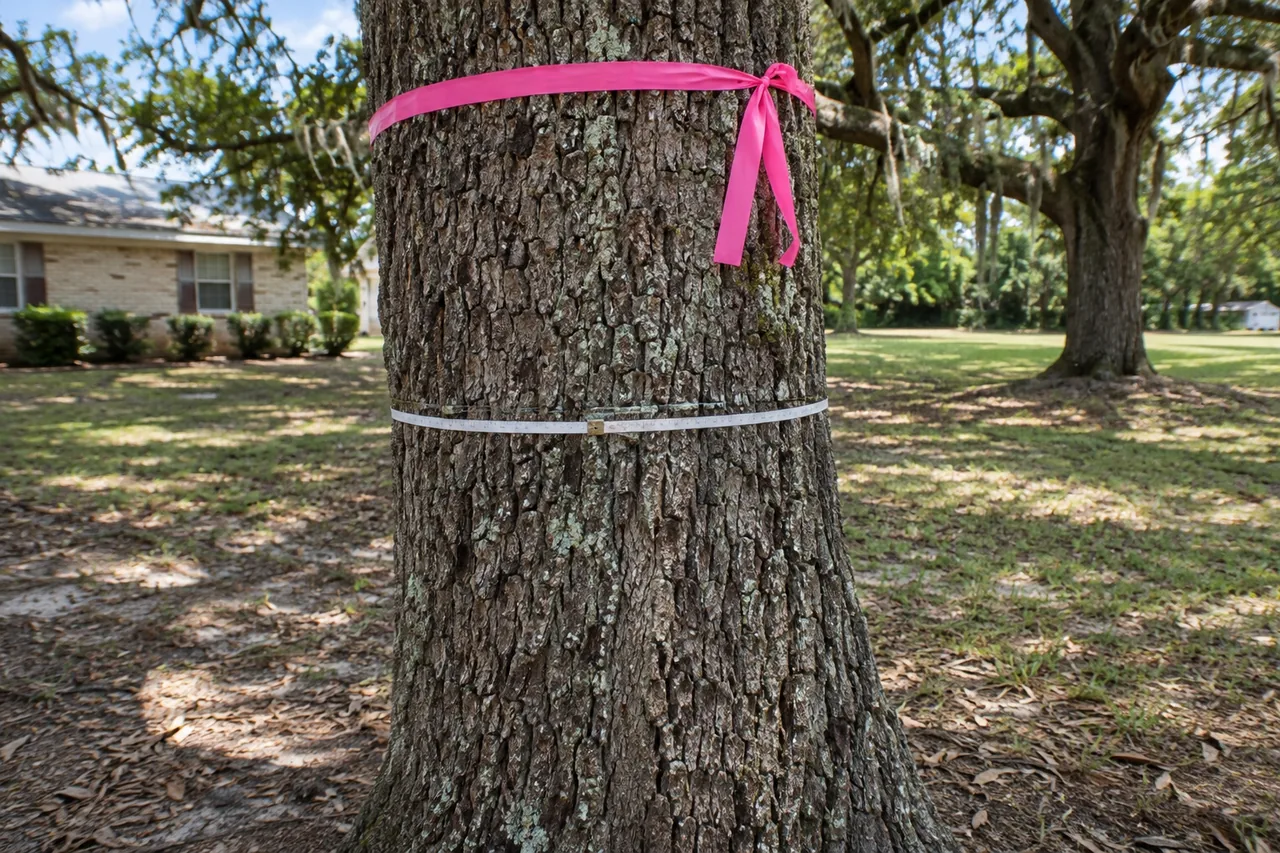
Every size is a trunk diameter at breast height (DBH), which Section 10.2 defines as the diameter "taken at a height of 4.5 feet." The definitions also give a circumference, for anyone measuring with a tape, and say to use whichever is less.
| Category | Size or test | What the definition adds |
|---|---|---|
| Regulated tree | 10 inches across or 2 feet around, whichever is less, at 4½ feet | "This definition shall not include any species of pine tree or nuisance tree regardless of size." Heritage and champion trees are regulated trees. |
| Heritage tree | 30 inches across or 7 feet 10 inches around, whichever is less | "A heritage tree is a regulated tree." |
| Champion tree | Listed by the Florida Division of Forestry as the largest of its species in Florida, or by the American Forestry Association as the largest in the U.S. | "A champion tree is a regulated tree." |
Because heritage and champion trees are defined as regulated trees, and the regulated-tree definition excludes every pine, the code as written leaves pines out of all three categories. A homeowner with a 32-inch longleaf pine in a city yard should still confirm with the city before cutting, since the code does not say this in so many words.
The definitions also say what "remove" means for Section 6.2.1: "the actual removal and effective removal through killing, damaging or destroying any regulated, heritage or champion tree." Girdling a heritage oak or burying its roots under fill counts the same as cutting it.
Does a tree on a house lot need a city permit?
Only if it is a heritage or champion tree. Section 6.2.1(F)(1) lists the exemptions, and the first one covers "Regulated trees, except for heritage or champion trees, on all lots and parcels of land" "with a single-family residential dwelling unit, not to include mixed-use portions of developments." The same item goes on: "No person shall cut or remove any heritage or champion tree from any such lot or parcel of land" "without first obtaining a tree removal permit from the City."
So on a house lot in the city:
- A 22-inch laurel oak: no city permit (regulated, but exempt on a single-family lot).
- A 34-inch live oak: permit needed (heritage).
- A 36-inch loblolly pine: not a regulated tree at all under the definitions.
- A tree of any size on a mixed-use or commercial parcel: the exemption does not reach it.
What other exemptions does Section 6.2.1(F) list?
The other items in 6.2.1(F)(1), in short form:
- Declared emergencies. During hurricanes, windstorms, floods and other natural disasters, "the requirements of this section may be waived for a definite period of time by the City Manager." The waiver is not automatic; it has to be issued, and it runs for a set period.
- Hazardous trees. "Any tree determined to be in a hazardous condition by the Land Development Regulations Administrator," so as to endanger people and property and "require immediate removal," is exempt. The determination is the city's.
- Agricultural land and bona fide commercial forestry, each with notice requirements, and permits still needed for some champion and heritage trees on agricultural land.
- Utility and drainage easements, for work done by the operator responsible for the easement.
- Nuisance and invasive species, whose removal is exempt.
On top of these, state law gives the owner of a single-family home a separate route for a risky tree: Florida Statute 163.045, covered on the state law page. A city cannot require its permit, fee or replanting where the owner holds the signed risk assessment that statute describes.
What does the city's tree removal permit application ask for?
The form is the "Land Development Regulations Tree Removal Permit Application," revised 1/23/2019 (City of Alachua, checked Nov 28, 2026). It asks for:
- The applicant, and whether they are the owner or an agent. An agent submits an executed Authorized Agent Affidavit.
- The property address, parcel ID, existing use and acreage, and where on the property the trees stand.
- How the trees are marked on the ground, for example with ribbon or paint.
- Each tree to be removed, by species and diameter at breast height (4½ feet).
- Which justification applies (Section D.1): an immediate safety hazard; harmful insects or fungi; no other reasonable or economic alternative; or progressive damage to buildings or structures.
- A replacement plan (Section D.2), with Attachments 1 and 2 required.
The form also says that incomplete applications are not accepted. It does not list a fee; ask Planning and Community Development at (386) 418-6121 when you call.
What replanting does the city require?
Section 6.2.1(D)(1) and the application spell it out:
| Tree removed | Replacement |
|---|---|
| Healthy regulated tree | One for one |
| Healthy heritage or champion tree | Inch for inch |
| Palms used as replacements | 3 palms for each tree, at least 8 feet tall at planting |
Replacement trees must be Florida No. 1 grade or better, at least half must be shade trees and at least three quarters site-appropriate, and they stay back from hydrants and utility poles (10 feet), driveway aprons (15 feet), traffic signs (20 feet) and intersections (25 feet). The owner keeps them alive and has an arborist, forester or landscape architect look at them within six months of planting. Where trees can't go back on the lot, the code allows a fee in lieu of planting, set by City Commission resolution.
Inch for inch adds up fast. A healthy 36-inch live oak means 36 inches of new trees; at a typical 2- to 3-inch nursery size, that is a dozen or more trees, or the fee in lieu.
Can a champion tree ever come down?
Only "by resolution of the City Commission," under Section 6.2.1(D). The request has to be backed by an arborist's written report showing the tree is dead, seriously diseased with treatment impractical, or damaged beyond what pruning can fix. Champion trees are rare, but San Felasco Hammock Preserve State Park, whose north trailhead is on US 441 in Alachua, has "several champion trees," according to Florida State Parks (checked Nov 28, 2026).
Can the city make me remove a dead tree?
It can. Section 6.2.1(E)(2) gives the city "the right, but not the obligation, to cause the removal of any dead or diseased trees on private property within the City, when such trees constitute a hazard to life and property." The Land Development Regulations Administrator notifies the owner in writing, and "the removal shall be done by said owner at the owner's expense within 30 days after the date of mailing of such notice." If the owner doesn't act, the city can remove the tree and charge the cost.
Section 6.2.1(E)(1) asks owners to prune branches over a street or sidewalk so they don't block the light from a street lamp, and to keep a clear space of eight feet above the sidewalk.
What happens if a protected tree is cut without a permit?
Section 6.2.1(H) makes it "unlawful for any person to cut or remove any regulated, heritage or champion tree from any lands within the City without first obtaining a tree removal permit," unless an exemption applies. Unpermitted removal or site work brings a stop-work order and a restoration plan due within 30 days; no certificate of occupancy issues until the plan is carried out. Fines are set by the City Commission and heard by the Special Magistrate (6.2.1(H)(4) and (6)).
On a building project, Section 6.2.1(H)(2) adds that land with regulated, heritage or champion trees can't be cleared, graded or developed, and no building permit issues, without a tree removal permit, "except as exempted within this section." An addition, a pool or a new shop building near a heritage tree is where a homeowner can run into this.
How do I measure the trunk?
- Find the spot 4½ feet above the natural ground line, the height Section 10.2 uses.
- Wrap a cloth tape around the trunk there. If the trunk splits below that height, ask the city how it wants the stems measured.
- Divide the distance around by 3.14 to get the diameter. A trunk 94 inches around (7 feet 10 inches) is 30 inches across, the heritage line.
The city's definitions let you use the circumference figure directly: 2 feet around for a regulated tree, 7 feet 10 inches around for a heritage tree, whichever is less.
Am I inside the City of Alachua or in the county?
An Alachua mailing address doesn't settle it: much of the land around the city with an Alachua (32615 or 32616) address is unincorporated county, where the county tree code and its 20-inch line apply instead. The Alachua County Property Appraiser's parcel record shows the taxing district.
Questions about City of Alachua trees
Does trimming need a permit?
Section 6.2.1 regulates removing, killing or destroying a regulated tree. Ordinary pruning isn't listed as needing a permit, but pruning so hard it kills a heritage tree falls under "remove" as defined.
Is a laurel oak a nuisance tree?
Not by name in the text read. The regulated-tree definition excludes pines and "nuisance" trees, and the exemptions include nuisance and invasive species. Invasive trees such as camphor tree and Chinese tallow are the likelier fit; ask the city which species it counts before relying on this.
Who handles a tree in the city right-of-way?
The scope covers all real property inside the city limits. A street tree between the sidewalk and the road is the city's call, so ask the city before anyone touches it.